





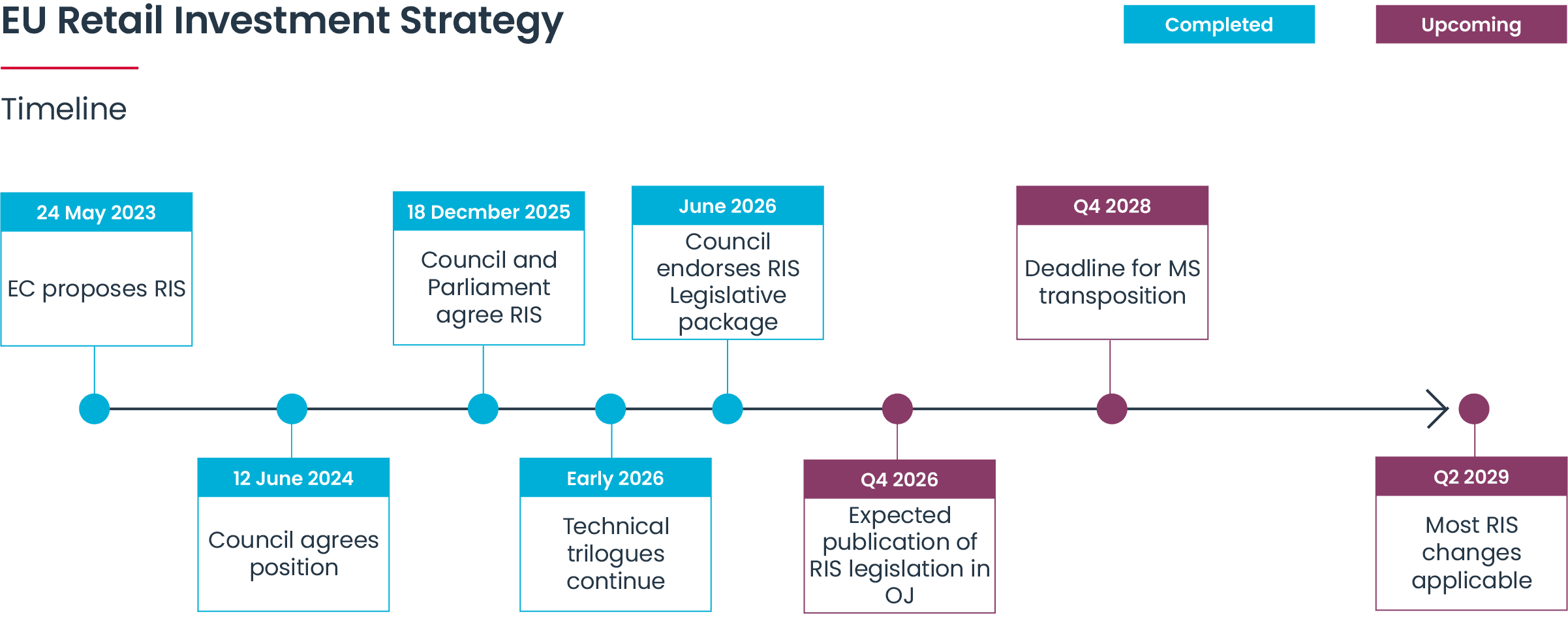
The final text of the EU Retail Investment Strategy (RIS) was approved by the Council of the EU (the Council) in June 2026, following political agreement by the Council and the European Parliament (the Parliament) in December 2025.
RIS overhauls the EU retail investor protection framework and amends the UCITS Directive, AIFMD, MiFID II, IDD, Solvency II and the PRIIPs Regulation. It forms part of the EU’s broader Savings and Investments Union (SIU) agenda.
The package takes the form of an omnibus directive amending the directives plus a regulation amending the PRIIPs regime (respectively, the Omnibus Directive and the Amending Regulation). Formal adoption and publication in the Official Journal are expected in Q4 2026.
Given the political agreement reached in December 2025, the Parliament is not expected to make substantial changes to the Council-approved legislation before the November vote.
Member States will have two years to transpose the Omnibus Directive. The Amending Regulation will have direct effect. Most provisions are expected to apply 30 months after entry into force, which is currently anticipated to be around Q2 2029.
We take a look here at some implications for UCITS management companies and AIFMs (Management Companies).
Undue Costs
Management Companies will be required to establish a process to prevent charging undue costs to investment funds and their unitholders. This involves the identification, analysis and review of costs charged, directly or indirectly, to investment funds or their unitholders.
A cost is treated as “due” only where it satisfies each of the following conditions:
- it is disclosed in the fund’s prospectus or key information document (KID);
- it is necessary for the fund to operate in line with its investment strategy or with regulatory requirements; and
- it is borne by unitholders in a fair manner.
Unitholders will be compensated where undue costs have been charged.
In addition, instances of undue costs must be reported to the home national competent authority (the NCA, being the Central Bank of Ireland (the Central Bank) for Irish-domiciled funds), the depositary and the fund’s auditors.
Value-for-Money (VfM) Assessment for Retail Funds
Cost Identification and Assessment
Management Companies must:
- identify and quantify all costs and charges borne by retail investors; and then
- assess whether product costs are justified and proportionate relative to fund performance, benefits and product features.
Marketing costs and/or inducements borne by investors must be separately identified and quantified.
This assessment should be carried out at the level of the fund, or when the fund has share classes with different cost structures, at the level of each share class.
The proposed legislation requires a Management Company’s management body to receive information from the compliance function on VfM assessments and any remedial actions taken to ensure funds offer value for money to retail investors. Under the proposed legislation, Management Companies shall make that information available to their NCA upon request.
Peer Group Comparison
Management Companies must carry out a peer group comparison of the fund’s costs and performance against a representative peer group of comparable funds marketed in the relevant Member State and, where feasible and proportionate, in other Member States. The aim of this is to assess whether the product is an outlier compared to similar products.
Funds identified as having costs and performance that differ significantly from those of their peer group, to the detriment of the client, must be remediated and should not be manufactured or distributed if VfM cannot be demonstrated.
Distributors and Funds Underlying Insurance Products
Management Companies must provide distributors with complete and accurate information on the VfM assessment.
Management Companies must also make all relevant VfM assessment information available to the insurance product manufacturer where a fund is used as an underlying investment option within an insurance-based investment product.
Board Accountability and Governance
Management Companies’ Boards must define, oversee and remain accountable for the adequacy and effectiveness of both the undue costs assessment and the VfM assessment.
Reporting
Management Companies must report the costs and charges borne by investors (including inducements) and fund performance data to their NCA.
VfM assessment records must be retained for at least five years, extending to seven years where required by the NCA.
Widening of MiFID II professional client regime
The RIS reforms broaden the circumstances in which a retail investor may elect to be treated as a professional client under MiFID II. In particular, the existing requirement to hold a financial instrument portfolio exceeding €500,000 will be reduced to €250,000, assessed on an average basis over the preceding three years. The means by which investor knowledge and experience may be evidenced has also been broadened.
Managers and directors of funds and Management Companies, directly involved in the entity’s investment activity (portfolio management, asset allocation or investment strategy) can be regarded as professional clients.
AIFM employees working in management or marketing would be treated as professional clients solely in respect of investments in the specific AIFs on which they work. Employees who could be treated as such would include those directly participating in portfolio management or risk management functions, as well as employees engaged in the distribution or sales of the funds who are required to understand their features, risks and investment strategies in order to market them to investors.
PRIIPs Key Information Document (KID) Changes
New Product at a Glance Dashboard
A new section called “Product at a glance” containing a summary of the product type, the summary risk indicator, the total costs of the PRIIP, the recommended holding period and whether the PRIIP offers insurance benefits must be included in the KID.
Inclusion of Sustainability-Related Objectives
The sustainability section is removed from RIS proposals and instead dealt with in the SFDR 2.0 proposal. The latest position is to include a section entitled ‘How sustainable is this product?’, which would set out the product’s categorisation in accordance with Article 7, 8 or 9 of that regulation, and include a description of its objective including relevant indicators.
New Performance Information Presentation Rules
The Amending Regulation gives ESMA, EBA and EIOPA (the ESAs) flexibility to determine new rules on “appropriate information on performance” and, where relevant, the assumptions used to generate that information. The ESAs may permit a combination of forward-looking performance scenarios and past performance information where this is considered meaningful for a particular type of PRIIP.
Electronic and Machine-Readable KIDs; layering
Under the new regime, KIDs must generally be provided to retail investors in an electronic format, unless the investor specifically requests a paper copy. In addition, KIDs may be presented using a layered format. Under this approach, investors can first see key headline information and then access more detailed information through subsequent layers. The first layer must contain the new “Product at a Glance” dashboard.
Three-page Limit Remains
Despite the new information requirements including the “Product at a Glance” dashboard, the three-page format of the KID is retained.
Retaining the three-page limit is likely to be challenging for KID producers given the introduction of additional mandatory disclosures. Producers will need to condense more content into the same space while ensuring disclosures remain clear, balanced and comprehensible for retail investors.
Standards and Guidance
Certain aspects of RIS will be detailed in Level 2 delegated acts and Level 3 guidelines including:
- cost disclosure templates;
- new requirements on dashboard content, layering, and digital presentation of the PRIIPs KID;
- performance information, cost comparability, technical feasibility of cost/risk display tools as well as minimum requirements for derogation for multiple investment option PRIIPs; and
- requirements for VfM peer group comparisons.
What Should Management Companies Do Now?
Management Companies can begin to:
- review existing undue costs monitoring and VfM assessment methodology against the RIS requirements and identify gaps. Many Management Companies already operate annual reviews of fund costs and charges as part of their existing undue costs and value assessment arrangements, in accordance with ESMA and Central Bank of Ireland expectations. Existing oversight processes will generally form the starting point;
- scope potential peer group selection criteria and data sources, and consider data-sharing arrangements with insurance manufacturers where a fund is used as an underlying investment option within an insurance-based investment product;
- confirm board and compliance function ownership of the new assessments within the existing managerial functions framework; and
- incorporate the enhanced cost, charges and performance reporting requirements into regulatory reporting plans for funds.
Please contact any of our Asset Management & Investment Funds Partners or your usual contact at William Fry for further information.
